
The room where history talks back
CIVILISATION EXPLAINED
Fourteen stone arches, a wall of screens, and more than a hundred historical figures who answer when a visitor touches their name.
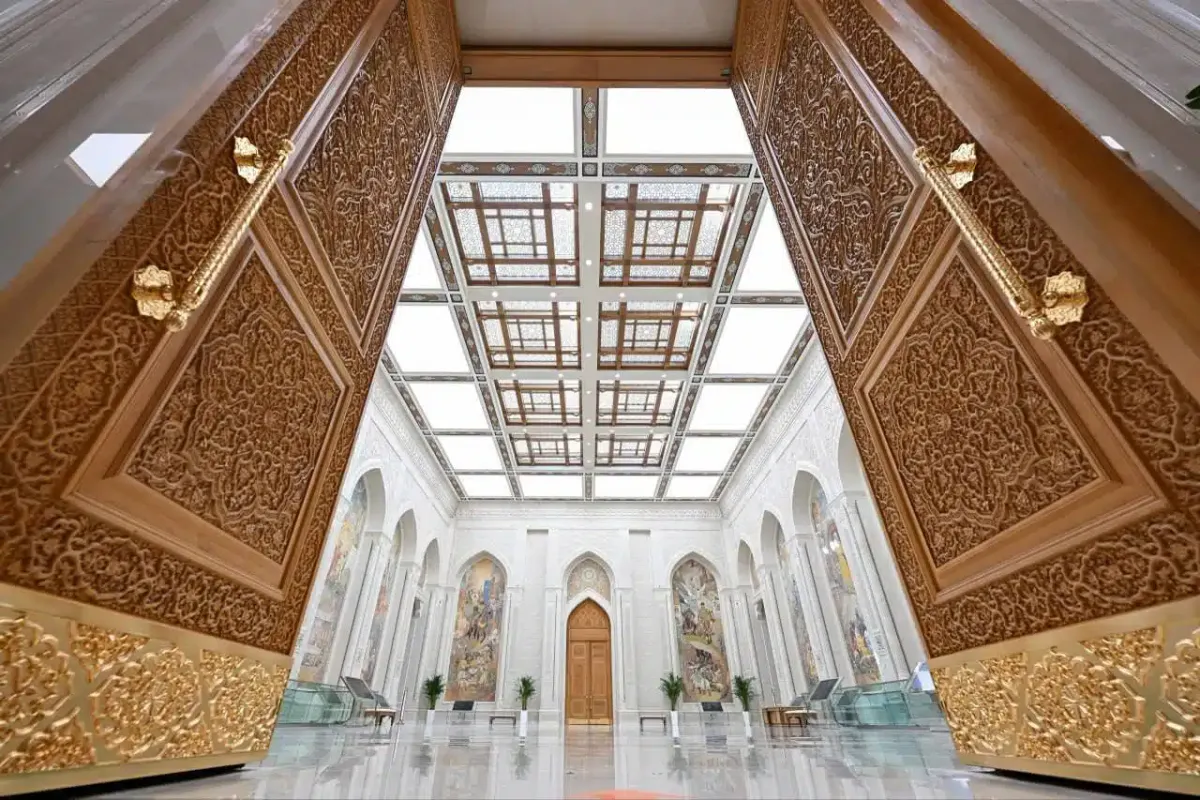
Most of the Center's exhibition halls ask a visitor to look. The Hall of Honour asks them to choose. Fourteen carved arches trace the landmark moments of Central Asian history and set into the walls between them is a bank of interactive panels wired to a single digital platform: touch a name, and one of more than a hundred scholars, poets and rulers appears on screen to describe, in their own words, what they discovered or wrote or built.
A hundred figures is a curatorial argument, not a gimmick
The number matters. A single talking portrait would be a novelty; a hundred is a claim about scale that Central Asia's contribution to Islamic civilisation was not the work of two or three towering names, but a sustained, crowded tradition of scholarship stretching across centuries. Al-Khwarizmi, the father of algebra and foundational mathematical algorithms, and Ibn Sina, the groundbreaking polymath who revolutionized early medical science, familiar to most visitors, stand alongside far more obscure figures a general audience would otherwise never encounter. The format makes room for both without ranking one above the other.
Why avatars, specifically
The choice of format is itself a piece of the Center's argument about itself. A wall of portraits and captions would tell a visitor about these scholars. A screen that responds when touched, and speaks back in something resembling a first-person voice, is built to make the encounter feel closer to a conversation than a lesson, the same instinct visible elsewhere in the Center's exhibitions, which consistently favour touch panels, projections and 3D reconstruction over static text and glass cases. One assessment of the Hall, from a journalist who toured it shortly before the Center's opening, described the approach as prioritising immersion and dialogue over static display, and the avatar wall is where that philosophy is most literal: history, quite deliberately, talking back.
What it's asking of a visitor
The format also makes a demand static exhibition doesn't. A visitor can walk past a captioned portrait and absorb a fact in passing; a hundred touch-activated figures require the visitor to choose whom to hear from, which means the Hall rewards someone willing to spend real time there, hunting for a specific name or simply working through the wall figure by figure. That's a different kind of museum-going than a single circuit of the galleries, closer to a reference library with the option to browse, an odd but deliberate choice for what is, on paper, one room in a much larger building. It rewards that kind of time in particular on an independent ticket, which the Center's own guidance suggests pairs with a visit of three to four hours; the roughly two-hour guided group tour moves through too quickly to let more than a handful of names get chosen.
Not only for scholars
The same instinct shows up a second time, aimed at a very different visitor. The Center's dedicated children's hall, which opened in November 2025, uses its own set of AI-animated historical figures to walk younger visitors through Central Asia's scholars and their discoveries, in Uzbek, Russian and English. It's a separate room with a separate audience built for play and curiosity rather than the Hall of Honour's density of reference. But it's built on the same underlying idea: that history lands better when it talks back. Between the two, the Center is betting that a conversation, however scripted, beats a caption every time whether the visitor asking the questions is a specialist chasing a name or a child meeting Ibn Sina for the first time.
Comments ()