
The room built around a single book
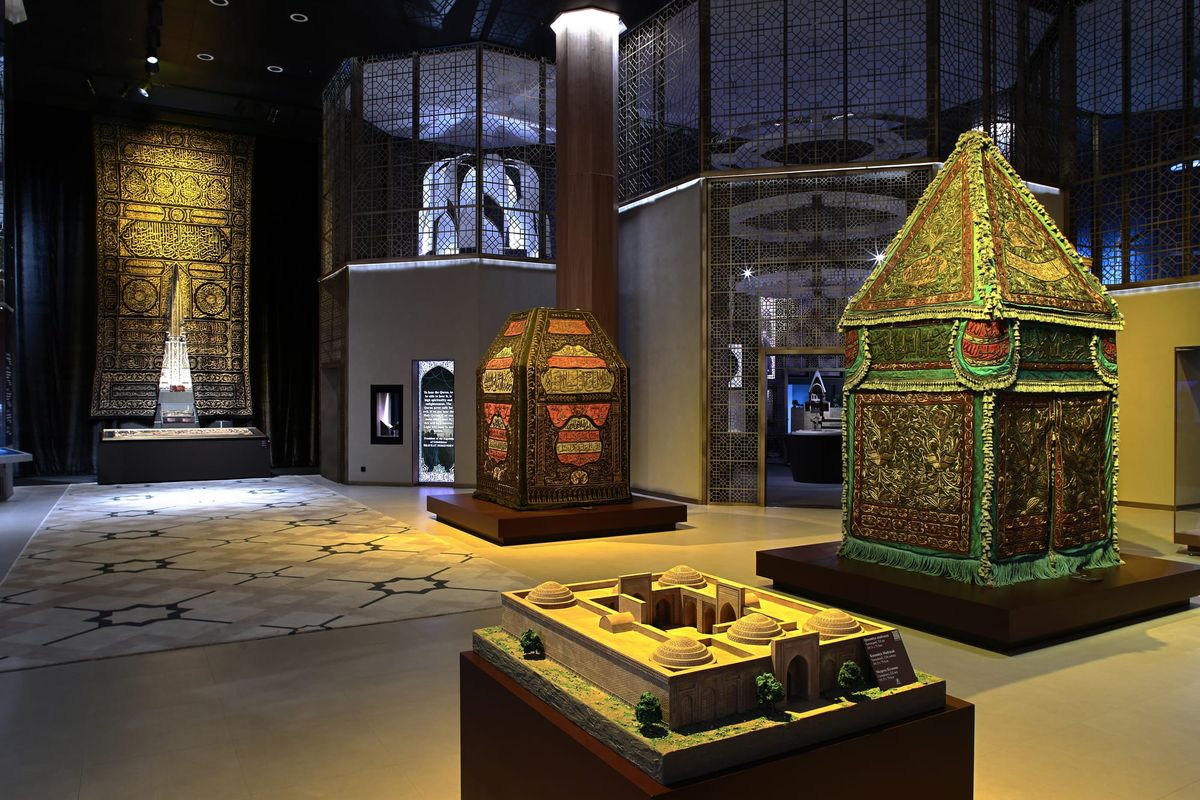
Walk to the architectural centre of the Islamic Civilization Center and you arrive at a room with one job: to hold a single book. The Qur'an Hall is both the conceptual and the physical heart of the museum, and the manuscript it was designed around is one of the oldest surviving copies of the Qur'an in existence — written in the seventh century on deerskin, and inscribed on UNESCO's Memory of the World Register.
It is known as the Mushaf of Uthman, and its age is precisely the point. Most of what the Centre exhibits — the Renaissance halls, the digital avatars of scholars, the interactive touch panels — is a modern museum's answer to the question of how you make centuries-old ideas legible to a visitor in 2026. The Qur'an Hall takes the opposite approach: it puts the original object in the room and asks the architecture to do the explaining. The hall doubles as a spiritual centre for the complex, and around the central manuscript sit further Qur'an manuscripts arranged according to the 114 surahs — a reminder that a single surviving text and a wider manuscript tradition are being presented side by side, not as substitutes for each other.
Why the object, not the technology, is the story
It would be easy for a Centre this heavily invested in interactive multimedia to let its newest technology dominate the coverage. But the manuscript itself is the harder-to-replicate asset — the reason scholars, diplomats and heads of state consistently name this room as the one they remember. A deerskin manuscript that predates the city's other Renaissance-era treasures by seven or eight centuries doesn't need an interactive panel to make its case. It needs a writer willing to sit with what it is, where it has been, and why a museum chose to build itself outward from that single point rather than around it.
Comments ()