

Five lotus flowers, and no one saying where they're from
MANUSCRIPTS AND HERITAGE
A gilded vessel bought at Christie's has gone on display in Tashkent for the first time. Its decoration raises a question the Center hasn't answered yet.
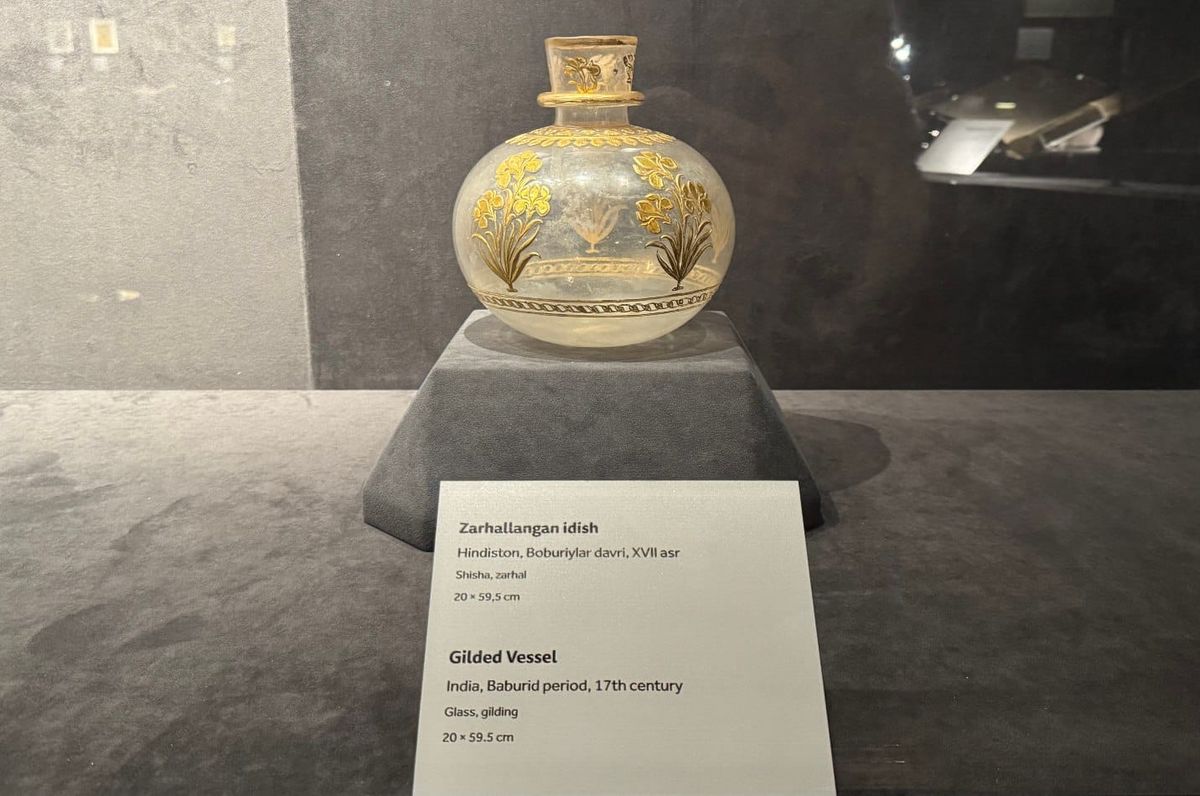
Most of what the Center displays arrived by way of a story: seized by an empire, returned by a government, or recovered by police from a London salesroom. The newest addition to the permanent exhibition arrived by a plainer route. A gilded vessel, roughly four hundred years old, was bought at Christie's, the London auction house, on the President's personal initiative, and is now on public display in Tashkent for the first time.
What it looks like
The vessel is spherical, built with cylindrical workmanship, and finished in polished gold leaf. A braided floral band runs around its lower section; above that, five gilded lotus flowers are arranged in a circle, the piece's central decorative motif. According to the Center's own scientific secretary, its manufacturing technique, ornamental style and state of preservation are what mark it out - a piece made for elite or courtly use, not for the table.
The gap in the story
What the Center's own description does not say is where the vessel was made, or by whom. No region, no workshop, no attribution beyond the seventeenth-century date. That's a genuine gap, not a minor omission: the lotus is an unusual motif to find at the center of an Islamic decorative object, more commonly associated with South and East Asian, and Buddhist, artistic traditions than with the courts of the Islamic world. It may simply reflect the kind of long-distance artistic exchange the Center's own exhibitions argue for elsewhere, Central Asia's position on trade and pilgrimage routes running in every direction. It may equally be a straightforward Persianate or Ottoman decorative convention that reads differently to an untrained eye. Without a stated origin, a reader is left to guess, and that is a detail worth putting directly to the Center rather than assuming.
A different kind of acquisition story
What makes the piece worth a Dispatch entry regardless of that gap is what it isn't. It isn't a restitution story, like the Kushan and Sogdian objects recovered by London's Metropolitan Police. It isn't a story of imperial seizure and political return, like the Mushaf of Uthman's long road back from St Petersburg. It is, by the Center's own account, a straightforward purchase on the international art market , a reminder that the collection is being built by more than one method at once: repatriation where there's a claim to make, and ordinary acquisition, at auction, where there isn't. The variety says as much about how the Center is assembling its collection as any single object does.
Comments ()