The machine behind the forum
Delegates arrived in Tashkent this week for a media forum. The real story is what the Centre had already built long before they got there.
This week's International Media Forum, “Islamic Civilization: New Look – New Discoveries,” brought delegates from 50 countries to Tashkent and Samarkand. But the more interesting story sits a little further into the Centre's own release, under a heading called “A growing global network”: this Forum wasn't the start of anything. It was a progress report on a media operation that has already been running for some time.
According to the Centre's own figures, its material has already reached media in 65 countries: 246 news items and sponsored features, seven full-length co-produced documentaries, 27 video projects, 23 television stories, and more than 60 books. None of that happened this week. All of it happened before delegates ever landed.
Whose idea this originally was
The reference point behind all of it is a single speech. In 2017, in his first year in office, President Shavkat Mirziyoyev told the UN General Assembly that Islam should be presented internationally as a religion of peace, knowledge and tolerance, rather than filtered mainly through the lens of conflict and security that has dominated much Western coverage of it. That proposal has since become the Centre's founding reference point: its mandate, its manuscripts and collections, its media partnerships, and now this Forum are all consistently described, by the Centre's own staff, as putting that one speech into practice, nine years on.
The documentary that already reached 418 million people
The clearest evidence is Echo of Enlightenment, a documentary series narrated by Sir Ben Kingsley, tracing the legacies of Al-Khwarizmi, Al-Fergani and Ibn Sina alongside the cultural achievements of the Timurid and Baburid eras. Broadcast across the BBC, CNN and Euronews, the series has reached a combined audience of more than 418 million viewers and one instalment, Whispers of Wisdom, has already picked up two international honours: the SILKFEST 26 award in Belgrade and recognition at the Terres Travel Festival in Tortosa, Catalonia. A documentary about ninth-century scholars, watched by hundreds of millions of people and carrying festival honours from Serbia and Spain, says more about the Centre's reach than the Forum's guest list does.
Partners doing distribution, not just attending
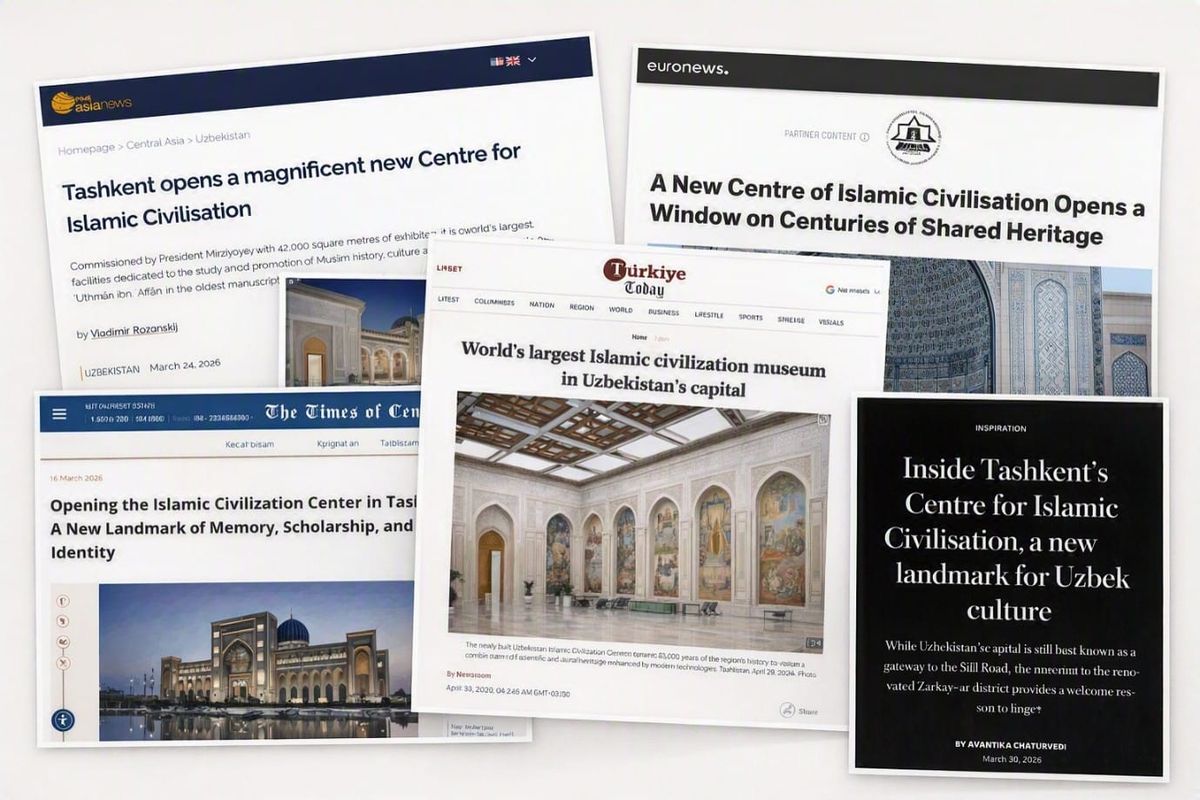
CNN and Euronews served as the Forum's general media partners, which undersells what they've actually been doing: more than 25 sponsored television and digital features on the Centre's history, architecture and collections, and on the return of cultural treasures to Uzbekistan, reaching a combined television audience above 400 million. TRT World and TRT Avaz have produced further documentary projects, and sponsored coverage of Uzbekistan's cultural heritage has already run in the BBC, The New York Times, The Washington Post, The Wall Street Journal and National Geographic. Cooperation with Al Jazeera Media Network is reportedly under discussion. The Forum's delegate list of 26 television and radio companies, 24 international publications, 14 newspapers, five international media associations reads less like a guest list and more like an org chart of an existing distribution network, assembled in one place for the first time.
What the Forum actually was
Read this way, the Forum wasn't the launch of a media strategy. It was the moment the Centre brought its already-existing partners into the same rooms, in Tashkent and Samarkand, to sign further cooperation agreements and identify the next round of films, books and digital projects. The Centre's director general, Firdavs Abdukhalikov, framed the event as translating President Mirziyoyev's 2017 UN address into concrete international media projects reaching millions of people worldwide - a claim that, on the evidence of the last few years, is not aspirational. It's already measurable.
How quickly the message already travelled
Within a day of the opening, Gulf coverage was already echoing the Centre's own framing closely. Peninsula Qatar reported that Abdukhalikov described the Forum as a way to translate President Mirziyoyev's vision into international media projects capable of reaching audiences worldwide, phrasing close enough to the Centre's own release that it reads less like independent reporting and more like confirmation the message is landing exactly as intended.
Times Kuwait went further than the wire release itself, quoting Abdukhalikov directly on why historical scholarship alone is no longer enough: heritage, in his account, now needs modern means of presentation, with the Centre positioned as a platform for teaching Islam and countering distorted portrayals of it abroad. Worth keeping in view: Times Kuwait's own editor-in-chief, Tareq Yousef Al-Shumaimry, addressed the Forum as a speaker, which is useful context for how that particular account came together.
Set alongside the reach figures already on record, the pattern holds together: the Centre's message isn't only being broadcast at scale, it's being reproduced in close to the same words, across several countries, within about a day of the Forum opening. That's a distribution network behaving exactly as designed.
Comments ()