

A king of France once wrote back to Amir Timur
MANUSCRIPTS AND HERITAGE
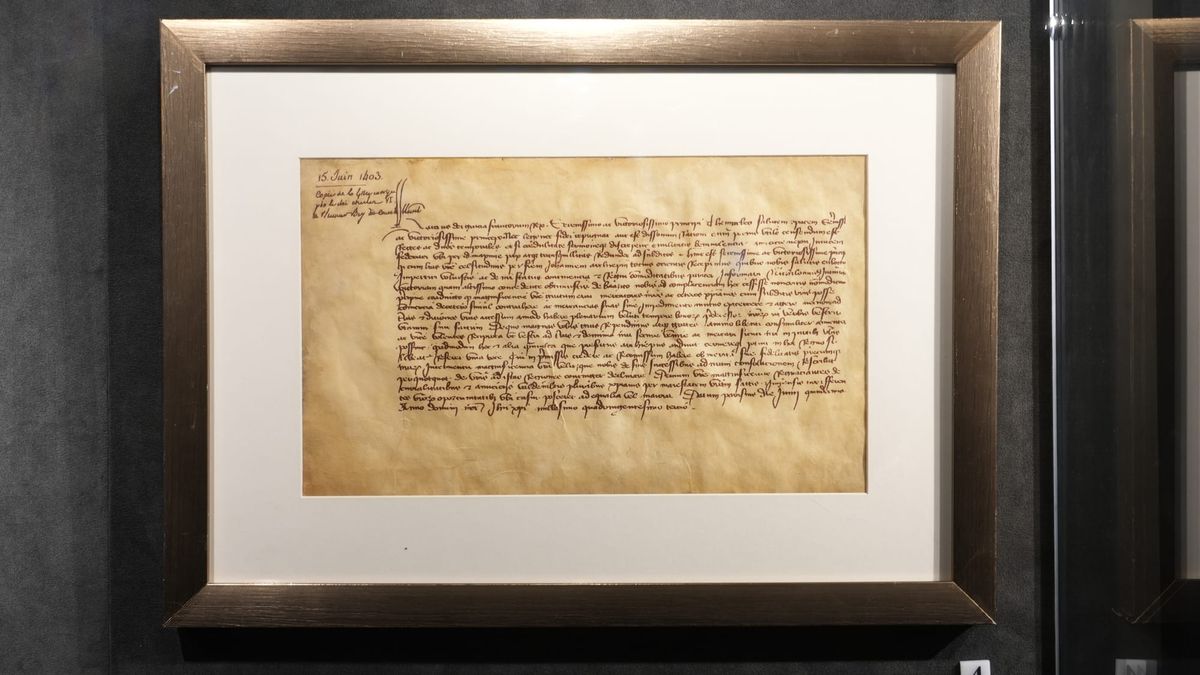
In 1403, Charles VI accepted Amir Timur's ‘useful proposals’ in a letter that is still held in Paris. This week, that 600-year-old correspondence is doing some of the diplomatic work for the Center's own trip there.
In the summer of 1402, Amir Timur defeated the Ottoman sultan Bayezid I at the Battle of Ankara, a victory that rearranged the balance of power across the Near East and unsettled courts as far away as Paris. Timur did what a ruler of his standing did with news of that significance: he sent word outward. One letter, dated 1 August, 1402, went to Charles VI of France, reporting the victory directly to the French king.
The reply
Charles VI wrote back the following year, on 15 June, 1403, addressing Timur throughout as “Temurbek” — the title the Central Asian ruler used at home, not a French invention. The pace was typical of the period: diplomacy by letter, carried overland across a continent, took the better part of a year to complete a single exchange. The reply survives, held today at the National Library of France, and it is warmer than a formality. Charles VI opens by asserting his own legitimacy, king “by the grace of the Creator,” before turning to the business of the letter.
“We accept your activities and useful proposals, and promise to show them equal and even greater favour wherever possible.”
— Charles VI of France, to Amir Timur, 15 June 1403
(Translation as published by the Center; the closing clause, “equal and even greater favour,” verified directly against the original manuscript.)
It's a small but telling detail: a Christian king invoking his own divine right in the same letter where he courts a Muslim ruler's favour — a reminder that medieval diplomacy between the two ran on protocol and mutual recognition of authority, not on theological alignment.
Uzbekistan and France are not discovering each other this month. The relationship runs back six centuries, through a Central Asian ruler and a French king who corresponded as equals long before either country existed in its present form — a more interesting claim than the usual language of bilateral friendship, and, unusually for this kind of claim, a verifiable one: both letters remain catalogued in Paris to this day.
A letter is a small thing to build a diplomatic narrative on. But it is also, unlike most of what gets said at a conference podium, a primary source: proof, rather than assertion, that the relationship predates this week's Paris conference and that Uzbekistan's case for its place in that room was being made in writing as early as 1402.
Comments ()